

07.09.2024
Reading "Living with complexity" by Don Norman
The book, authored by Don Norman in 2010, presents grounded theories on human-object interactions and design psychology.
Why I start reading?
During my time at PolyU School of Design, I encountered a diverse array of design theories, ranging from highly conceptual to more practical ones, spanning design history to design fiction. I hold the view that as a designer engaged in the commercial realm (or now as a product designer), it is crucial upon us to thoughtfully consider the products we create. Reading has equipped me with the necessary perspective to contemplate the interaction between technology and humanity.
Life is complex. Good design ≠ simple design
Nowadays, user experience has emerged as a buzzword across businesses. Designers are frequently tasked with simplifying processes, product outlook, and of course, user flows. Yet, it is often overlooked that humans are inherently complex beings. In today's intricate society, where both our lifestyles and the products we engage with are increasingly sophisticated, fixating solely on "simplification" as the guiding principle can lead us astray. It is unrealistic to expect designers to distill every concept to a level understandable by a 10-year-old. Simple design, while valuable in many cases, does not universally align with the diverse needs of users.
Complexity or Confusion?
In the book, it is particularly enlightening that, Don Norman argues complexity as a term that should be viewed neutrally, a perspective that contrasts with the common contemporary aversion to complexity among many designers. According to Norman, the crux of good design lies in whether a product is confusing or not. Designers bear the responsibility of empathizing with users, stepping into their shoes, and crafting mental models that alleviate confusion.
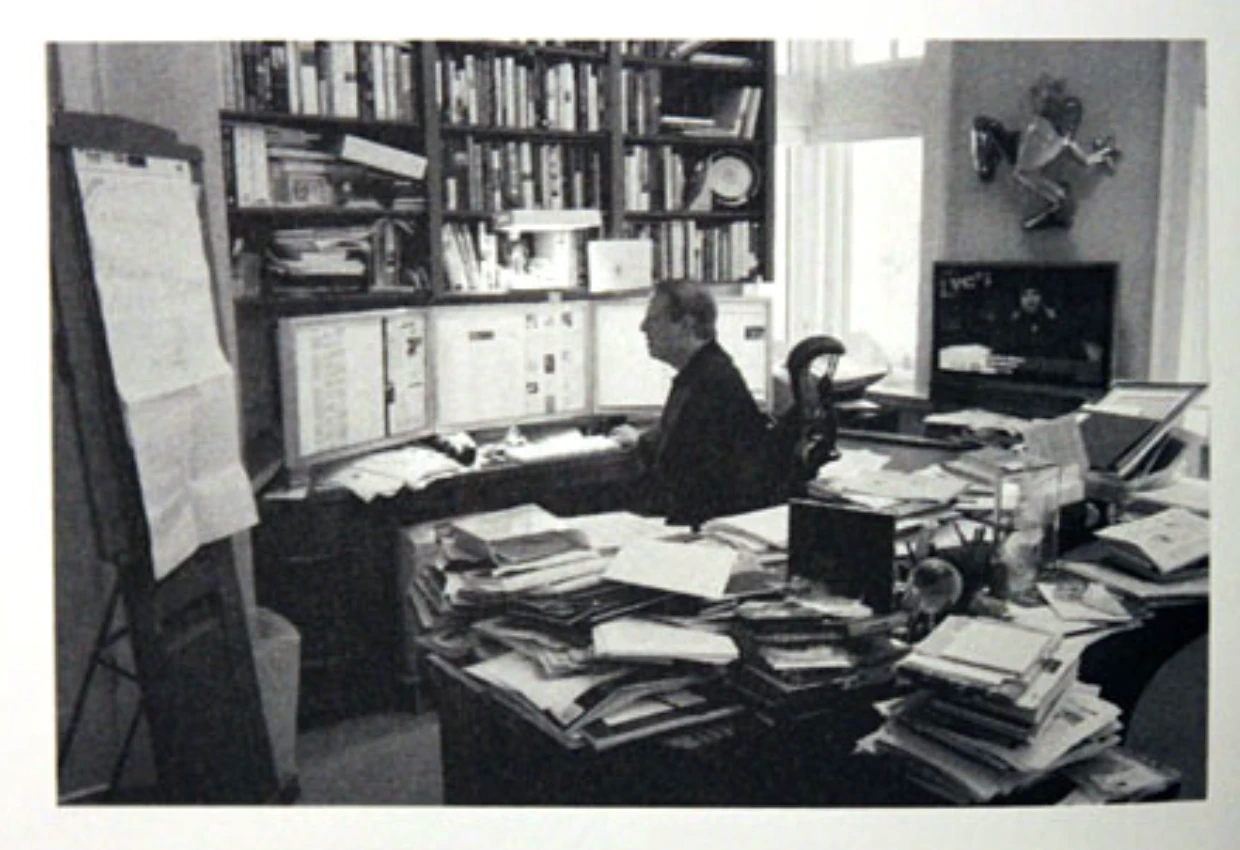
Gore's Desk
Norman presents a vivid example early in his book to illustrate this point. At first glance, an observer might perceive a cluttered desk and instinctively feel the need to tidy it up. However, the reality is quite different - Gore (the person in the picture) intentionally maintains the disorder on their desk, as he is able to locate all necessary items. Norman interprets Gore's desk as the chaotic yet organized reflection of a structured mind. He emphasizes that complexity does not necessarily equate to confusion.
What should we focus on?
As designers, our objective should be to guide users toward constructing mental models that facilitate problem-solving, rather than imposing simplistic solutions that fail to address their underlying needs. It is about assisting users in navigating complexity effectively rather than oversimplifying the design process and delivering solutions that fall short of meeting user requirements.